
Highlights
- Louise is an advanced copper-gold porphyry deposit in British Columbia, road accessible, and has seen limited exploration at depth or laterally.
- Historic drilling has returned strong copper and gold grades including 0.41% copper with 0.40 g/t gold over 158 metres.
- The deposit contains a historic resource with 924,333 ounces of gold and 658 million pounds of copper in the inferred category plus an additional 183,902 ounces of gold and 132 million pounds of copper in the indicated category.
- In May and June 2025 CANEX completed a deep looking induced polarization survey over the Louise deposit and surrounding area and identified 2 new high priority targets that have never been drill tested previously, these are:
- The West Louise Target located 2 kilometres west of the Louise deposit in a till covered area and defined by a high chargeability zone 600 metres wide by 400 to 500 metres deep, and extending at least 800 metres along strike.
- The Louise Deep Target located below and immediately north of the Louise deposit that is interpreted to be the main body or deep roots of the Louise deposit. This target is up to 700 metres wide and extends to 1000 metres below surface, the depth limit of the geophysical survey.
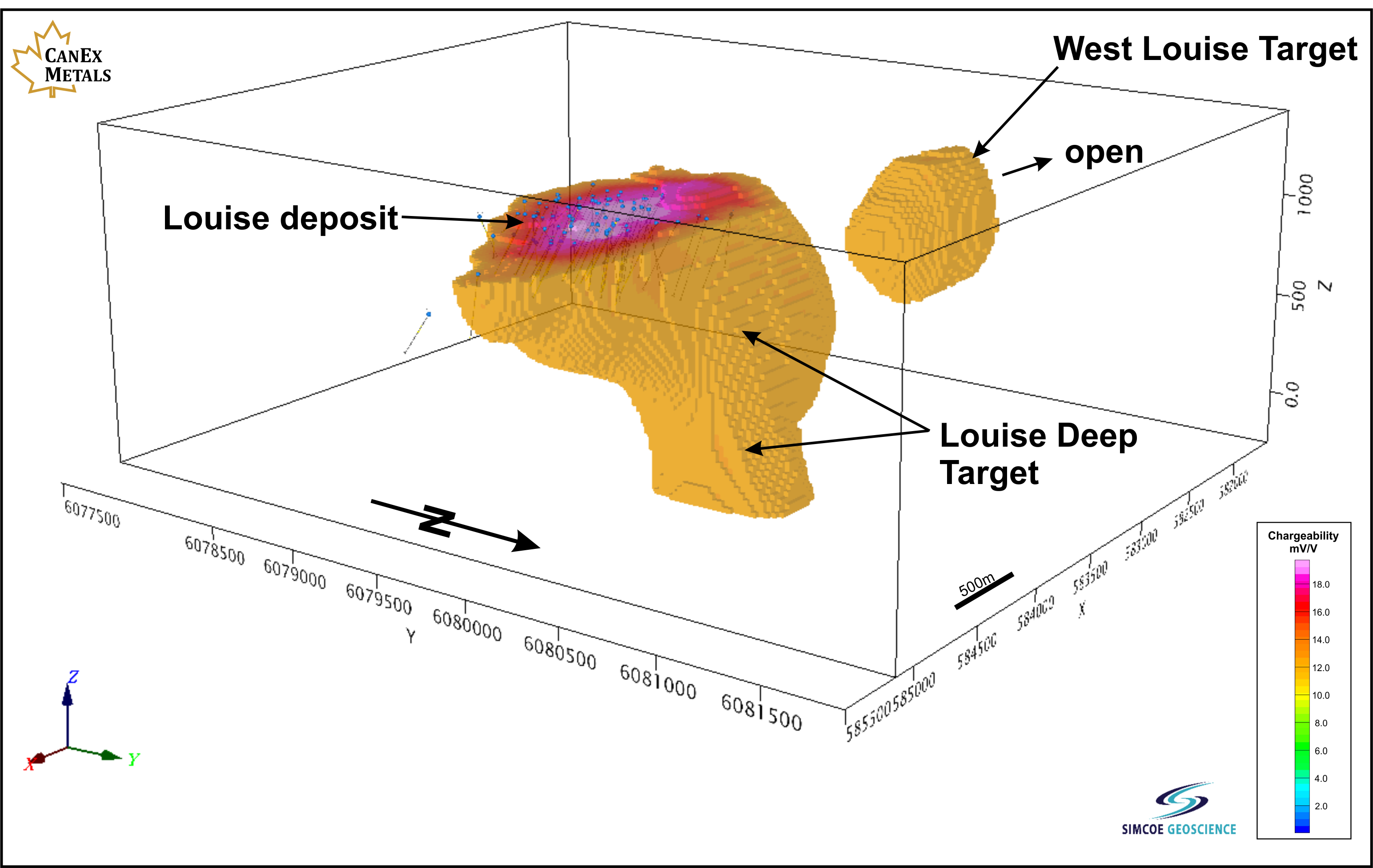
Figure 1. 3D Chargeability Model of the 2025 IP survey showing the 11.5 mV/V isosurface and highlighting the Louise deposit, the Louise Deep Target, and the West Louise Target. Oblique top-down view towards the southwest.
- Drill permitting is in progress

Introduction
The Louise Project is road accessible and located approximately 35 kilometres west of Smithers, in west central British Columbia. The property has been explored by a number of companies since the initial discovery of mineralization exposed at surface in the 1960's. Previous drilling has defined a near surface mineralized zone 1000 metres long by 100 to 200 metres wide, extending to about 270 metres depth.
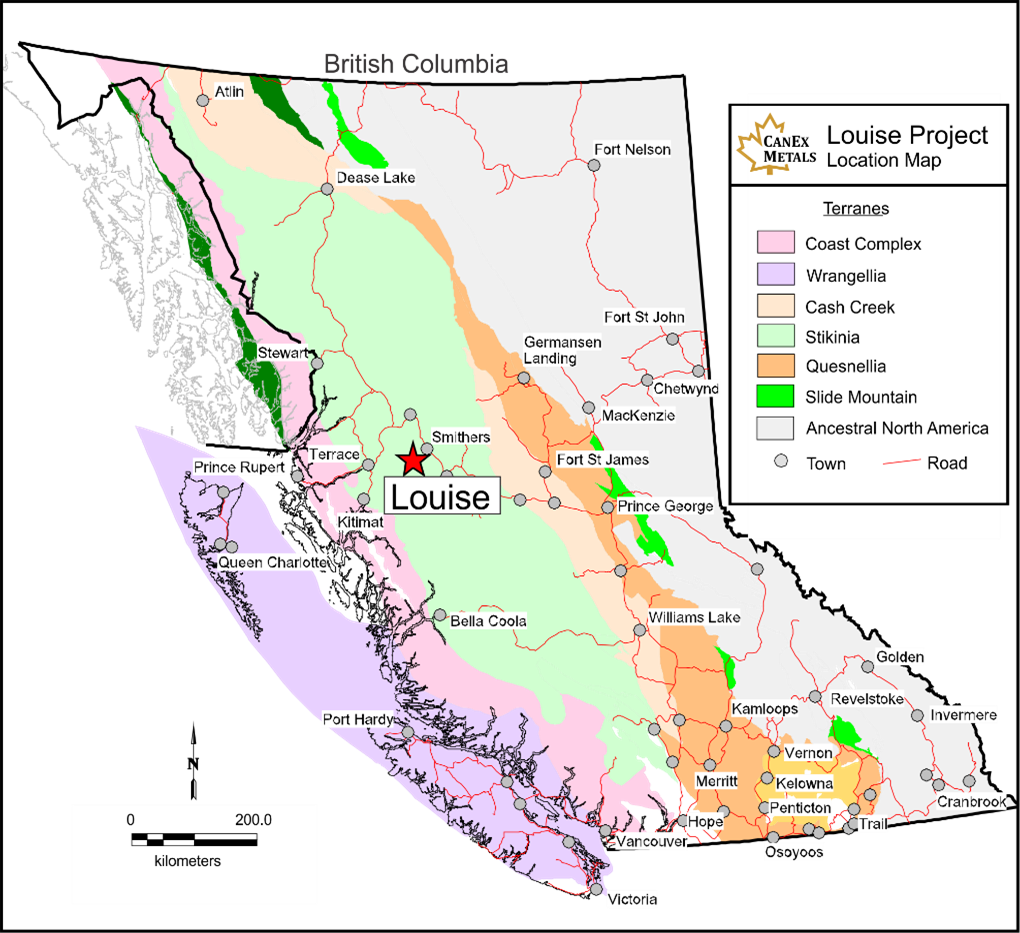
Figure 2. Location Map of the Louise Project.
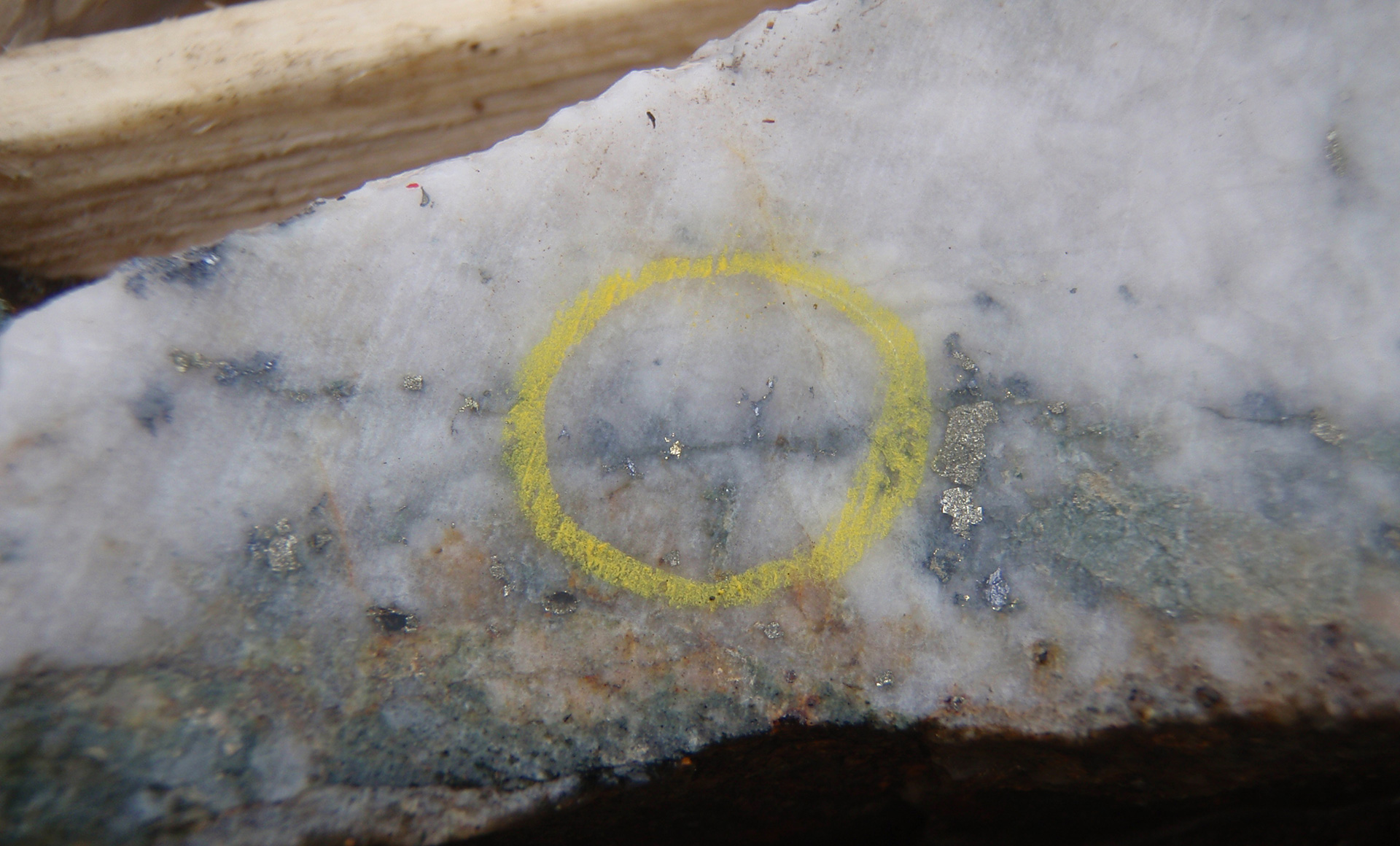
Mineralization occurs as chalcopyrite (CuFeS2), enargite (Cu2AsS4), and molybdenite (MoS2) disseminated and in stockwork quartz veins associated with sericite and argillic alteration. The known deposit has been disrupted by faulting and the roots of the system have never been identified or evaluated. No drilling has been conducted at the property since 2008 and the system has not been explored below about 350 metres depth. Past induced polarization (IP) geophysical surveys were shallow looking and done in the 1970's and 1990's.
Previous drilling has intersected strong copper and gold grades highlighted by hole LL04-03 which returned an interval of 158 metres grading 0.41% copper and 0.40 g/t gold starting at 53.5 metres downhole. Such strong grades, that appear to be increasing with depth, suggest good grade potential could exist in the main body of the porphyry system which is hypothesized to occur at depth or adjacent to the known mineralized zone.
A drill location map with copper and gold grades displayed along drill holes is shown in Figure 3 along with cross sections through the deposit in roughly north-south and east-west orientations in Figures 4 and 5. The data show a strong and continuously mineralized zone that extends from surface to around 270 metres depth. The mineralized zone consists of volcanic and sedimentary rock hosted mineralization along with mineralized monzonite intrusive dikes. A central controlling porphyry intrusion has not been identified and remains a key exploration target at Louise. A flat dipping fault termed the Terminator Fault truncates mineralization at depth.
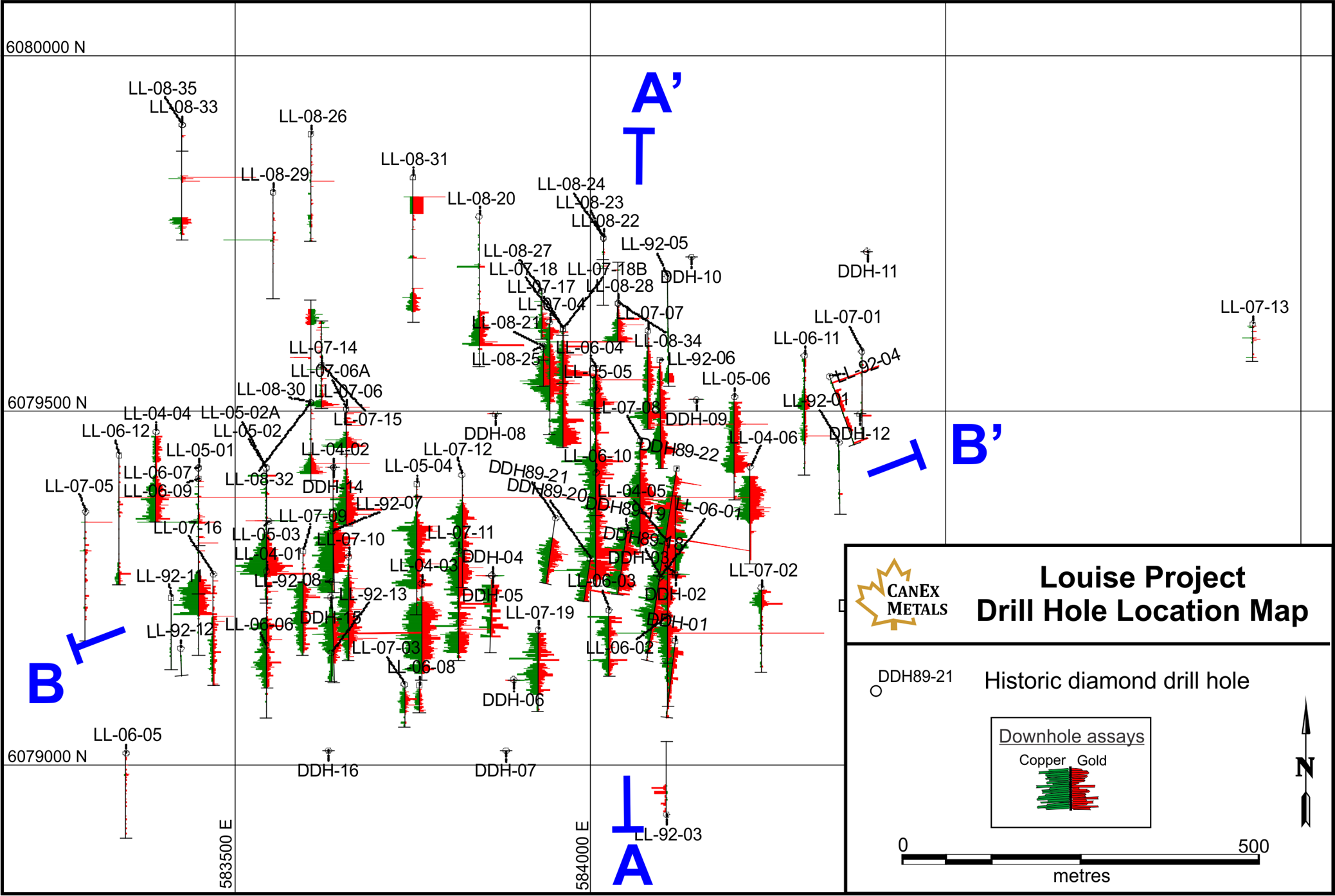
Figure 3. Louise Project drill hole location map showing copper and gold grades along drill hole traces.
The high-quality historic data for Louise provides an excellent basis for understanding the known zone of mineralization and planning cost effect, focused, and targeted exploration that could lead to a new discovery. Drill data review has strengthened the Company's thesis that there is excellent discovery potential laterally and vertically surrounding the known copper-gold zone, a concept that is supported by the 2025 IP survey.
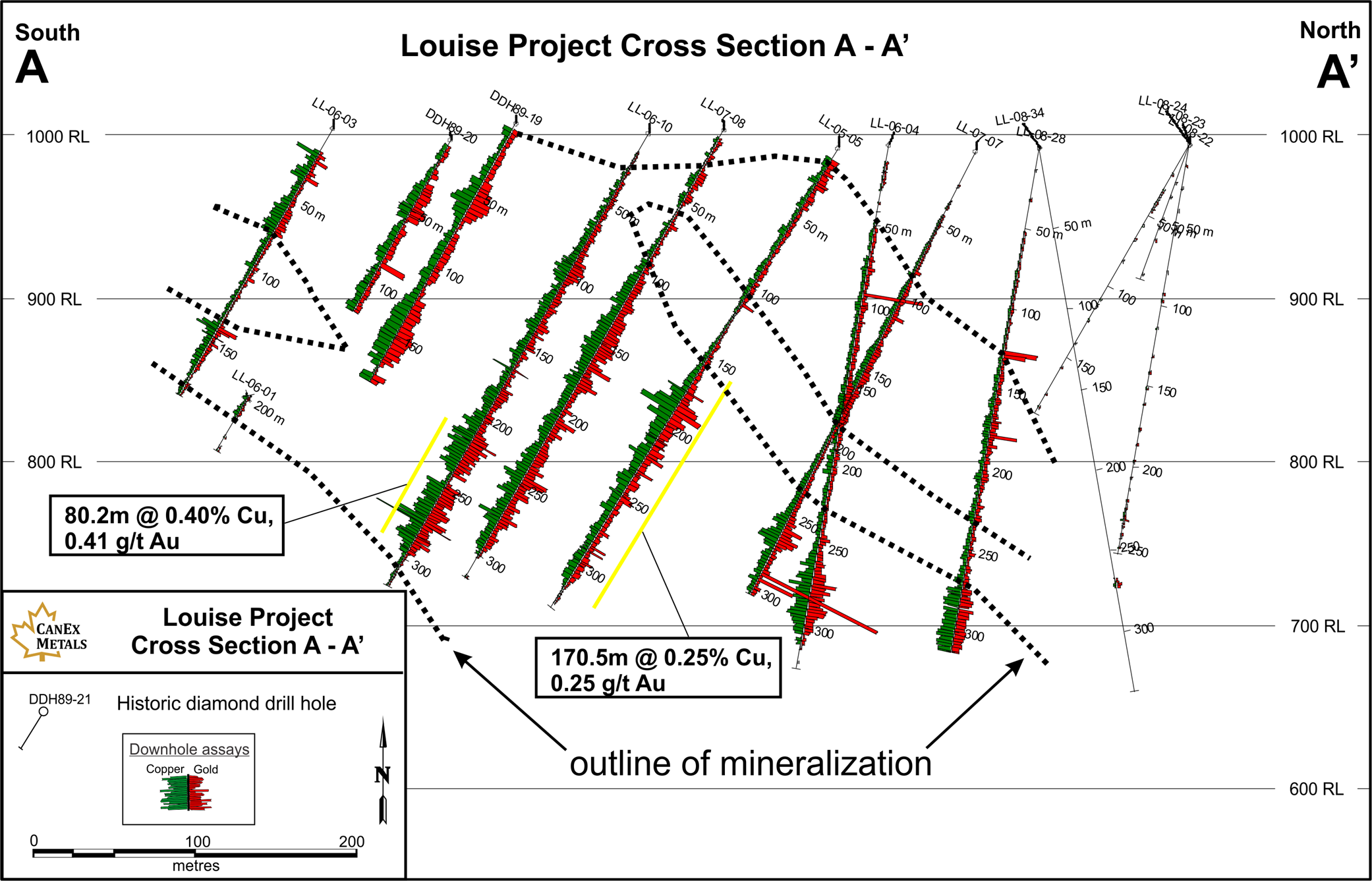
Figure 4. North-south cross section through the Louise deposit showing copper and gold values down hole and the outline of the mineralized zone.
Historic work prior to 2008, including drilling and geophysical surveys largely focused on the upper 300 metres of the mineralized system. The 2025 IP geophysical survey commissioned by CANEX Metals was designed to provide geophysical data to 1000 metres below surface and over a larger area than previous studies, opening up exploration potential below and lateral to the known zone.
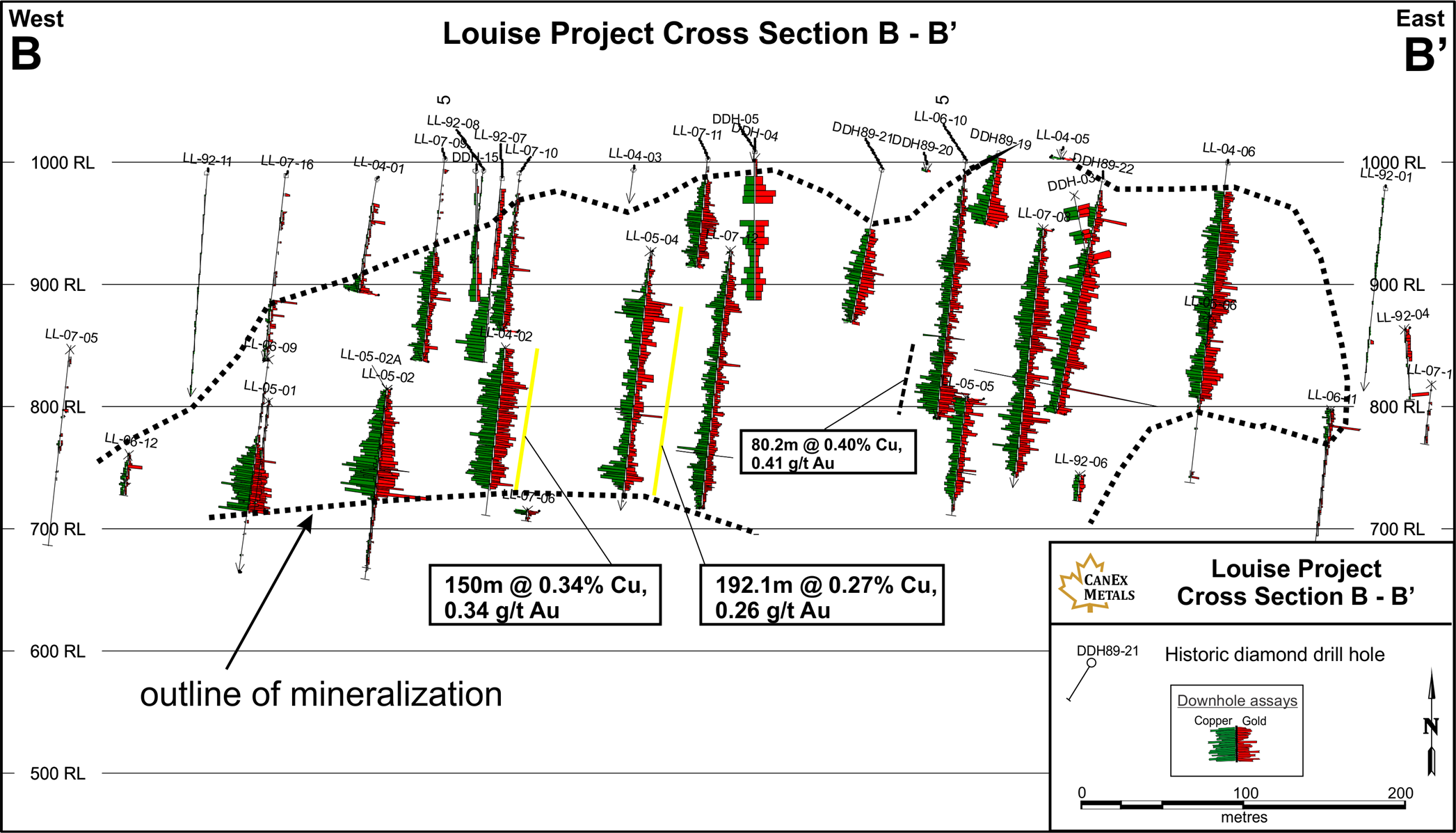
Figure 5. East-west oriented cross section through the Louise deposit showing copper and gold values down hole and the outline of the mineralized zone.
Table 1. Louise Project Historic Drill hole highlights
Hole | From (m) | To (m) | Interval (m)1 | CuEq (%)2 | Cu (%) | Au (g/t) | Mo (%) | Ag (g/t) |
LL04-03 | 49.5 | 253.5 | 204.0 | 0.57 | 0.37 | 0.35 | 0.012 | 1.2 |
including | 53.5 | 211.5 | 158.0 | 0.64 | 0.41 | 0.40 | 0.014 | 1.3 |
LL05-04 | 103.0 | 295.1 | 192.1 | 0.43 | 0.27 | 0.26 | 0.011 | 1.0 |
LL05-05 | 140.8 | 311.3 | 170.5 | 0.41 | 0.25 | 0.25 | 0.011 | 0.9 |
LL04-02 | 147.0 | 297.0 | 150.0 | 0.56 | 0.34 | 0.34 | 0.018 | 1.1 |
including | 188.9 | 293.0 | 104.1 | 0.67 | 0.42 | 0.41 | 0.019 | 1.4 |
LL06-10 | 208.8 | 289.0 | 80.2 | 0.60 | 0.40 | 0.41 | 0.005 | 1.5 |
LL05-02 | 221.6 | 300.3 | 78.7 | 0.78 | 0.45 | 0.44 | 0.037 | 1.2 |
1 Interval refers to drill hole intercept, true thickness is not known.
2 CuEq (copper equivalent) is provided for illustrative purposes only and is calculated using metals prices (USD) of $3.75/lb Cu, $2000/oz Au, $18/lb Mo, and $22/oz Ag using recovery assumptions of 85% for Cu, 55% for Au, 80% for Mo, and 44% for Ag.
The Louise Project contains historic resource estimates conducted in 2006 and 2007. The Company is not relying on these estimates but is using them as a positive exploration guide demonstrating that a strong porphyry system occurs at the project and gives insight into the character and controls on mineralization. The project contains a large amount of high-quality surface and drill hole exploration data that will aid immensely in the understanding of the system and the targeting of new zones.
Table 2. Louise Project Historic 2007 Resource Summary3
Contained Metals | ||||||||
Category | M Tonnes | CuEq%2 | Cu% | Au g/t | Mo% | Ag g/t | Cu lbs | Au oz |
indicated | 26 | 0.36 | 0.231 | 0.22 | 0.008 | 1.01 | 132,409,743 | 183,902 |
inferred | 125 | 0.38 | 0.239 | 0.23 | 0.009 | 0.99 | 658,631,546 | 924,333 |
3This historic resource estimate for the Louise Project is historic in nature, was not issued to CANEX Metals, and has not been verified by the Company or a qualified person for the Company. The resource estimate was done to CIM standards but CANEX is not treating it as a current mineral resource estimate. It is considered relevant as a guide for future exploration and is included for reference purposes only. The historic resource estimate was done in 2007 by SRK Consulting (Canada) Inc. for North American Gem Inc. The initial resource was reported in a technical report dated July 2006 and titled "Independent Technical Report and Resource Estimate for the Louise Lake Property, Omenica Mining Division, British Columbia." The resource was updated in 2007 incorporating an additional 13 holes drilled in 2007. The 2006 technical report utilized 59 drill holes with resource estimation carried out by ordinary kriging using Gemcom software. A 0.15% copper equivalent cut off was used assuming metal prices of (USD) $1.20lb/Cu, $450/oz/Au, $8/lb/Mo, and $7/ozAg, with no provision for recoveries. The historic resource estimate is not constrained by a conceptual open pit.
Louise 2025 Induced Polarization Survey
From May 13 to June 12, 2025, Simcoe Geoscience conducted a geophysical survey at the Louise Project using their Alpha IPTM wireless time domain distributed induced polarization technology. A total of 36.9 line kilometres on nine lines were surveyed, each line was 4100 metres long and spaced 400 metres apart. The survey used a 100-metre dipole spacing with a dipole-pole-dipole (reverse & forward) configuration enabling double data density to be acquired providing high definition and resolution. The survey was completed on time and under budget.
Figure 6 shows the 3D chargeability model for the 2025 IP survey at 800 metres elevation. The Louise deposit stands out as a large chargeability high as does the new West Louise Target, a zone that has not been identified or drill tested previously. Both zones overlap with surface Cu-Au-As-Mo soil and silt anomalies, with the till covered West Louise Target showing lower level and patchy anomalies.
A prominent zone of high chargeability extends across the survey area in an east-west orientation and remains open to the east and west. Additional geophysical surveying will be considered to define the extents of the trend in both directions. Following the geophysical survey the Company submitted mineral claim applications, which if granted, will cover a prospective 16 kilometre trend across the district.
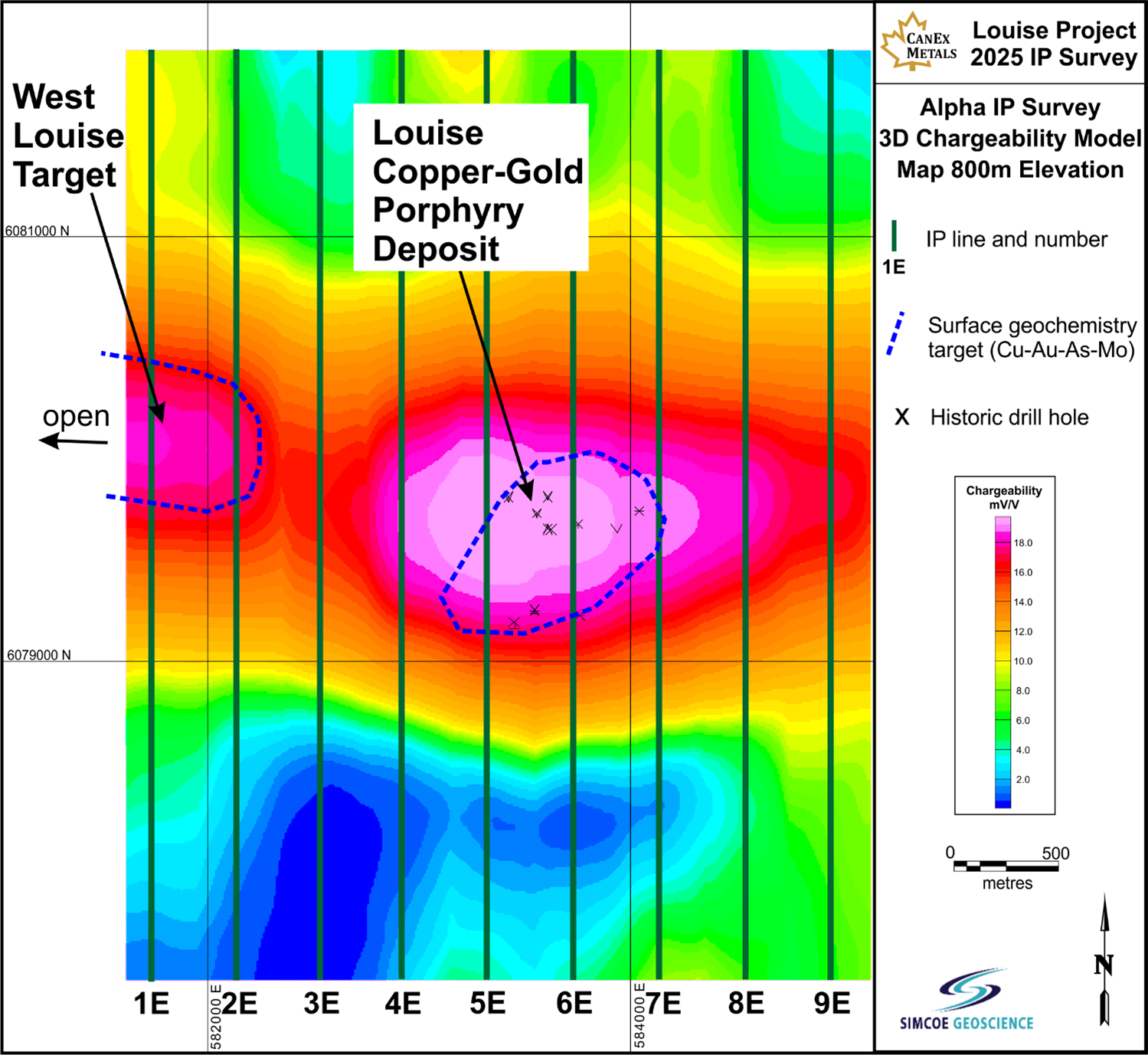
Figure 6. Map of the Louise Project showing the 3D chargeability model at 800m elevation and the location of the 9 geophysical lines recently completed. Surface geochemistry anomaly outlines are shown as blue dashed lines.
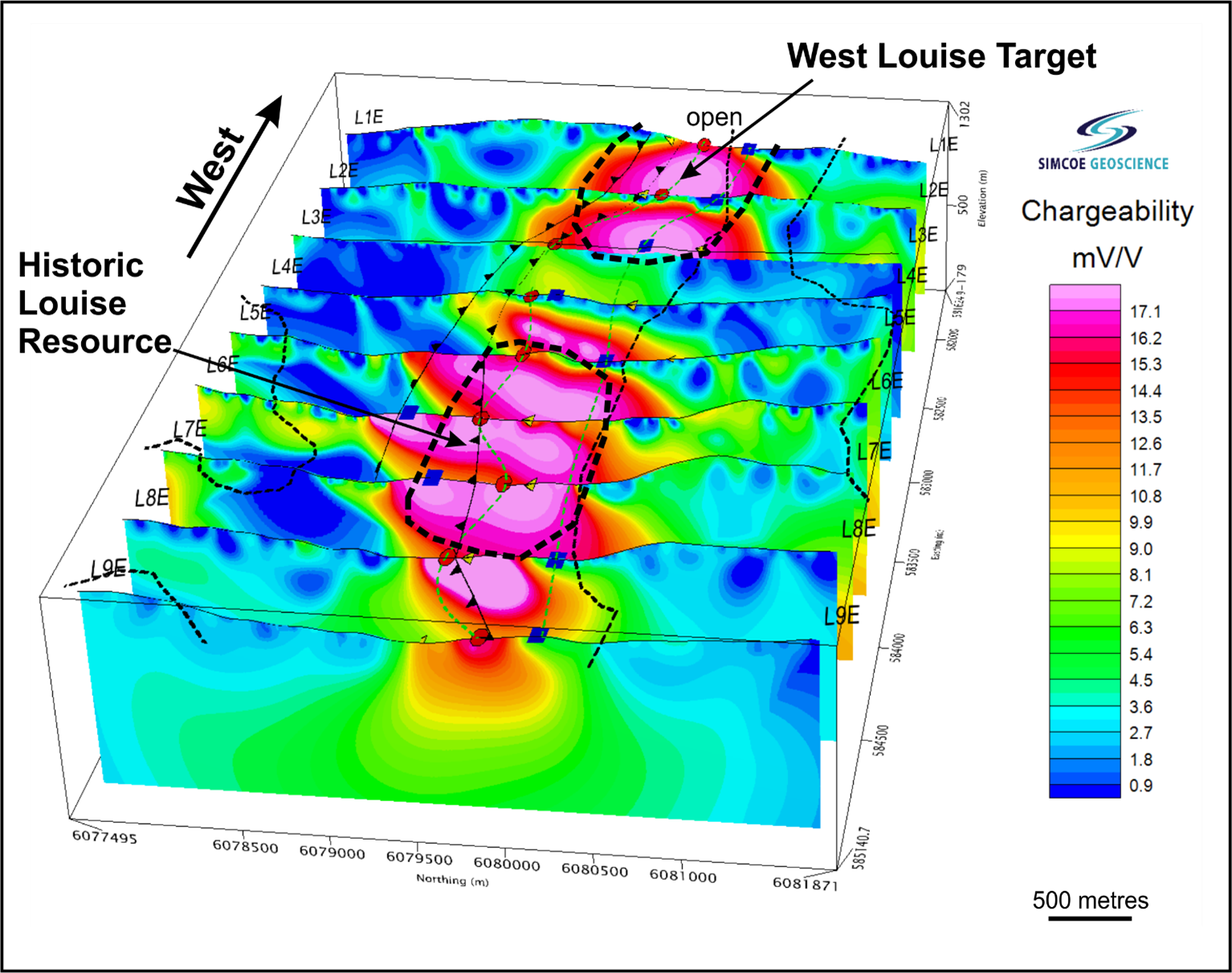
Figure 7. 2D stacked sections showing chargeability highlighting the historic Louise resource area and the new West Louise Target that remains open to the west. Top down view looking toward the west.
Figure 7 shows a series of stacked cross sections and highlights the high chargeability zone associated with the historic Louise resource and the high chargeability feature at the West Louise Target which remains open to the west. Mineralization at the Louise deposit typically has chargeability values ranging from 16 to 22 mV/V and resistivity values ranging from 190 to <50 Ohm-m (moderate to strong conductor).
Figures 8 and 9 show geophysical cross sections 1E and 2E highlighting the high chargeability feature associated with the West Louise Target which has chargeability values ranging from 15 to >20 mV/v and resistivity values ranging from 150 to 50 Ohm-m. The West Louise Target extends over an area 600 metres wide by 400 to 500 metres deep and is at least 800 meters long and remains open along strike to the west. The anomaly comes to surface on line 1E and starts around 150m below surface on line 2E. On lines 1E and 2E the extent of moderate level chargeability values expand at depth, possibly suggesting the West Louise Target could represent the upper levels of a large sulfide alteration system. Additional geophysical surveying will be required to define the extent of the target. The West Louise Target has the same geophysical chargeability and resistivity expression as Louise copper-gold mineralization and has never been explored or drill tested previously. The zone is a high priority target that warrants immediate field follow up, drill permitting, and drill testing.
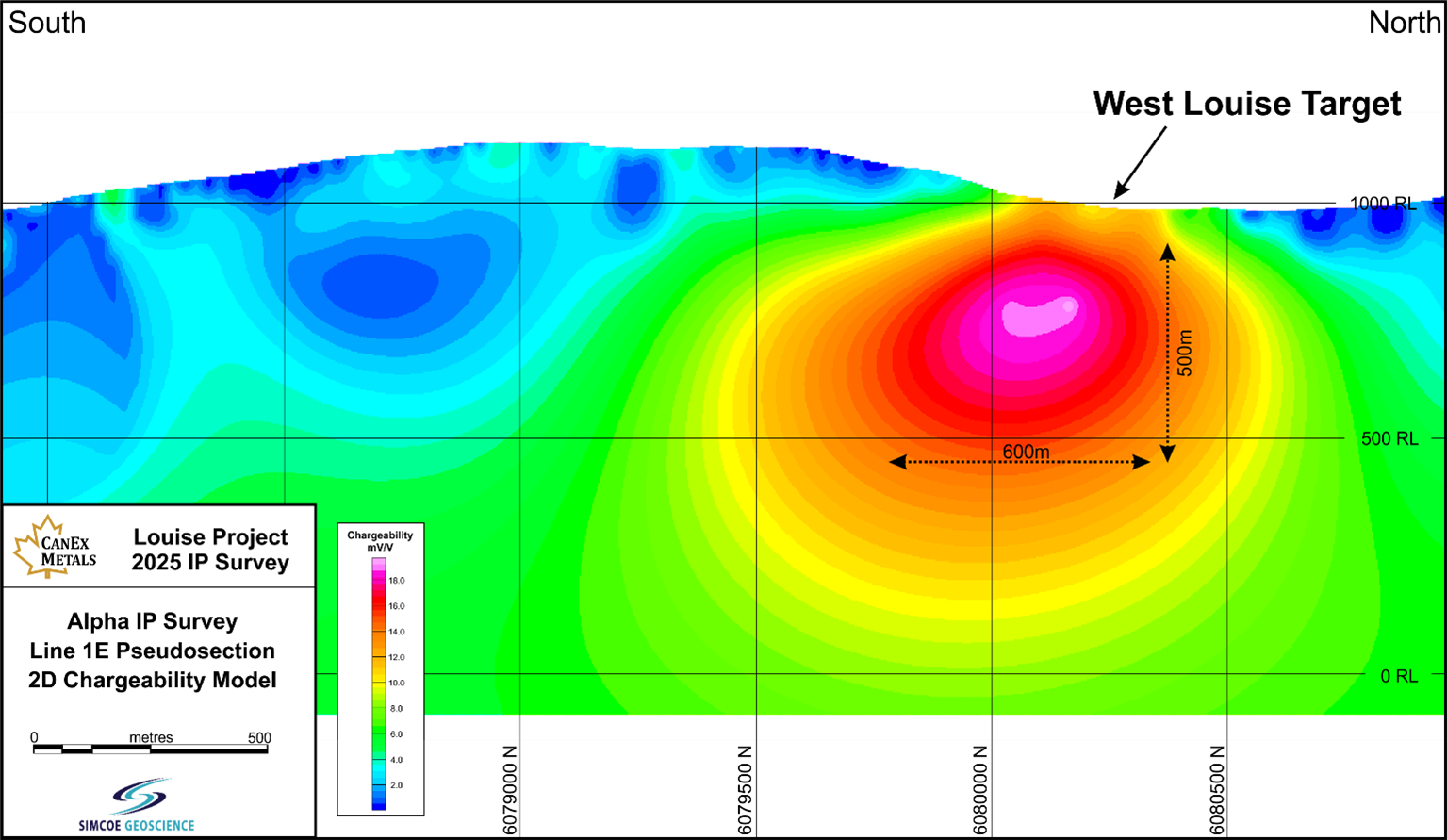
Figure 8. Pseudosection through the 2D chargeability model showing Line 1E and highlighting the West Louise Target. See Figure 6 for section location.
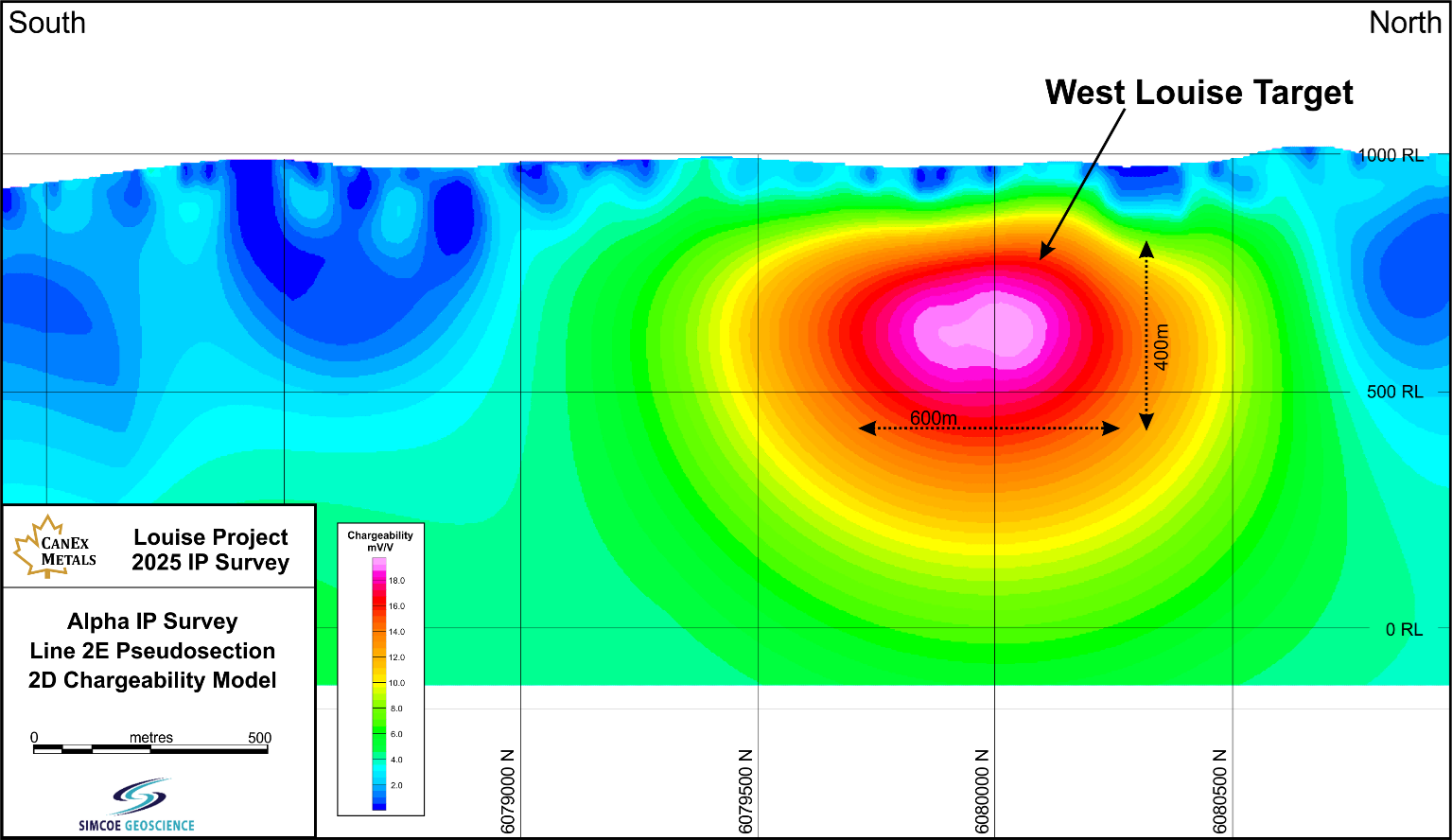
Figure 9. Pseudosection through the 2D chargeability model showing Line 2E and highlighting the West Louise Target. See Figure 6 for section location.
Figure 10 shows geophysical cross section 6E along with drilling and copper and gold values downhole, the interpreted flat dipping Terminator Fault, and the interpreted Louise Deep Target. The Louise Deep Target directly underlies the north edge of a large near-surface chargeability zone and is 700 to 900 metres wide and extends vertically for at least 750 metres to the limit of the geophysical survey. This target could be the conceptual "main body" of the Louise Porphyry that is partially offset from the historic resource along the Terminator Fault. Identifying this target was a key objective of the survey.
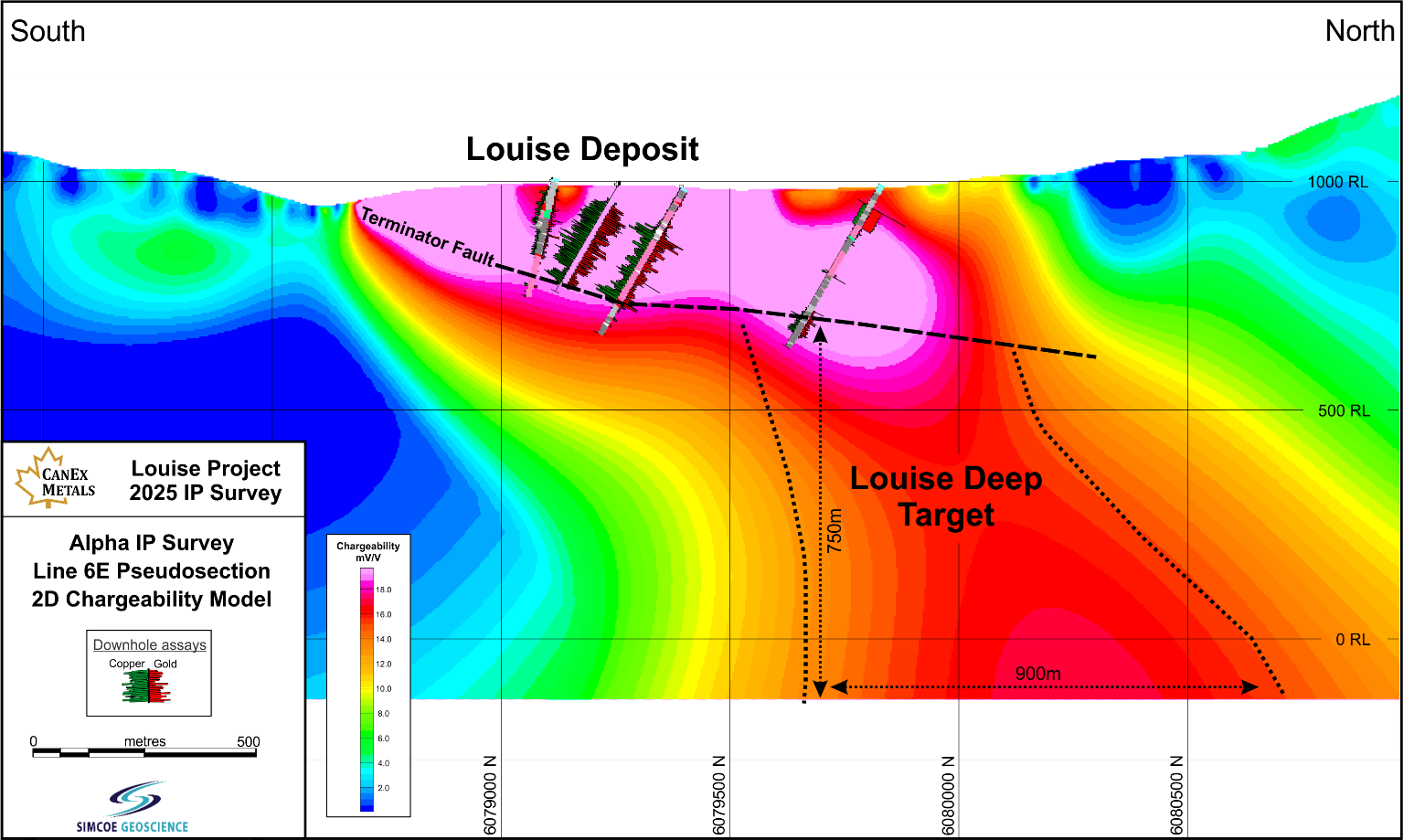
Figure 10. Pseudosection through the 2D chargeability model showing Line 6E and highlighting copper-gold mineralization at the Louise deposit, the Terminator Fault, and the Louise Deep Target. See Figure 6 for section location.
Louise Property Agreement
CANEX has entered into an option agreement to earn a 100% interest in the Louise Project from prospector Bernie Kreft. Under the terms of the option CANEX must make the following payments over a 5 year period to Kreft to earn a 100% interest in the project.
$10,000 in shares or cash on Regulatory Approval
$25,000 in shares or cash on or before March 1st, 2025
$50,000 in shares or cash on or before March 1st, 2026
$90,000 in shares or cash on or before March 1st, 2027
$200,000 in shares or cash on or before March 1st, 2028
$400,000 in shares or cash on or before March 1st, 2029
There are no expenditure commitments allowing CANEX to advance the project as market conditions allow. Kreft will retain a 2.5% net smelter royalty (NSR), with CANEX having the right to buy back 40% of the NSR (1% of the 2.5% NSR) for $1,500,000. CANEX will retain a right of first refusal on the sale of Kreft's royalty.
A milestone bonus of $50,000 in shares or cash will also be payable if CANEX drills over 4250 metres of core, and a second milestone bonus of $50,000 in shares or cash will be payable if CANEX publishes a resource estimate with greater than 1.5 million contained ounces of gold.
Next Steps
CANEX is in the process of permitting drilling at Louise to allow drill testing of the Louise Deep and West Louise Targets.